As the resumption of the Iran war escalates, with Washington and Tehran trading a deluge of strikes, President Donald Trump has again threatened to attack sites linked to Iran’s nuclear programme.
In the Oval Office on Tuesday, Trump was asked if he believes Iran has moved nuclear centrifuges into Pickaxe Mountain, an underground facility near one of the country’s primary enrichment facilities.
“They may have, we don’t have it on record,” Trump said. “It doesn’t mean anything unless they have the material [uranium]. We follow the material, that’s where the action is.”
“We’ll be hitting that area, probably pretty soon, and there’s not a thing they can do about it,” he added, having earlier vowed that “any site where they’re even thinking about nuclear, we’ll be hitting it very powerfully.”
This is far from the first time Trump has threatened to strike Pickaxe Mountain, known in Iran as Kuh-e Kolang Gaz La.
The resumption of the Iran war on July 7, just weeks after the signing of the interim cease-fire agreement, has largely focused on the continued struggle over the Strait of Hormuz.
But the other long-standing prevalent issue surrounds Iran’s nuclear capabilities, as Trump has repeatedly stated that Tehran must never be allowed to build or procure a nuclear weapon.
“We’re going to take out Pickaxe Mountain. Tell the Iranians to be ready,” Trump said in a July 13 interview, once again bringing focus to the nuclear-linked site.
Amid the escalating threats and tensions, here’s what to know about the Iranian facility.
What is Pickaxe Mountain?
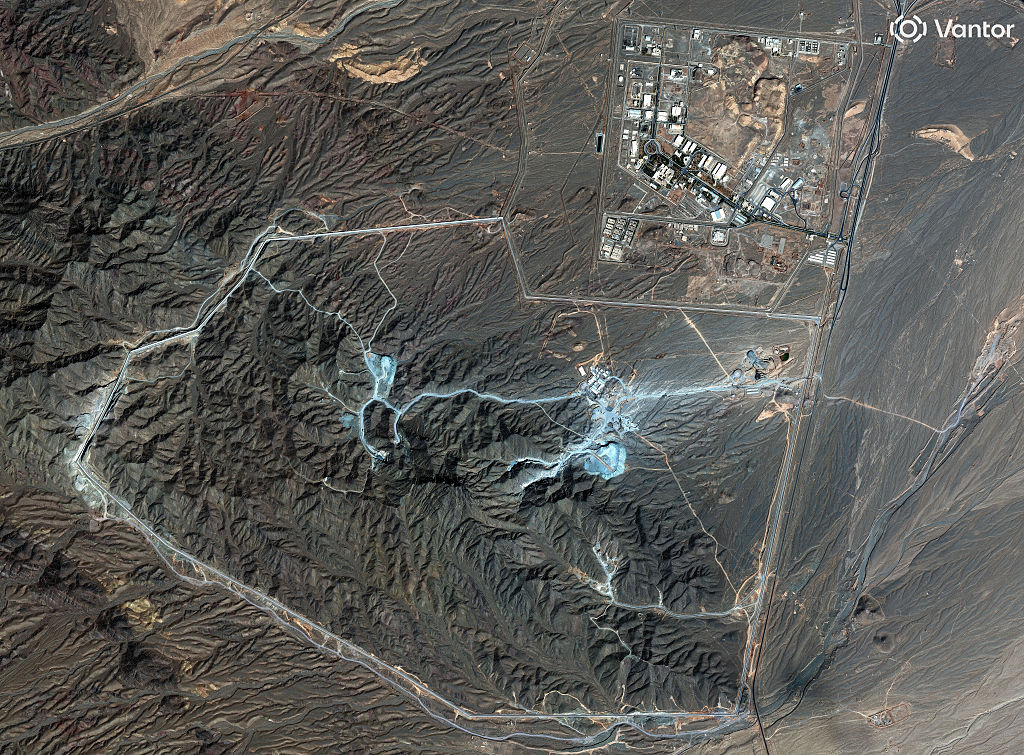
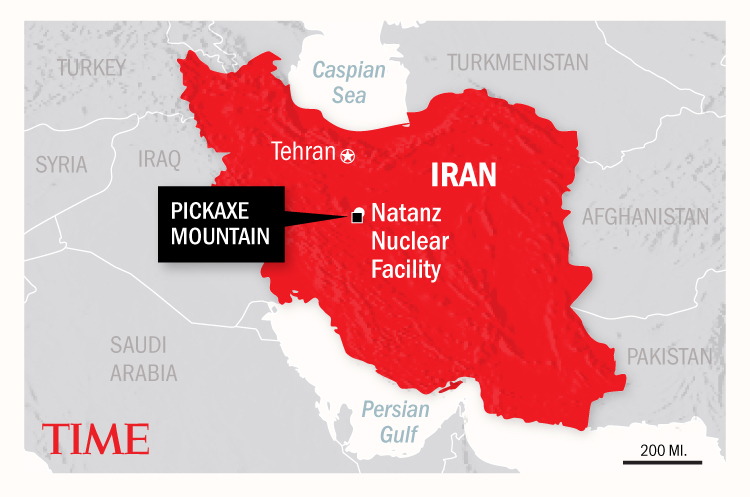
The underground site is situated around 220 km (140 miles) south of Tehran and 2 km (1.2 miles) from the Natanz nuclear complex.
In June last year, the U.S. joined Israel in launching strikes on three key Iranian nuclear sites—an action Trump said had “completely and totally obliterated” the targeted facilities.
Natanz was among the facilities hit, as it was believed to house highly-enriched uranium. The entrances to the nuclear site were targeted again in the early days of the Iran war which started on Feb. 28.
During last year’s 12-day war, the nuclear facility outside the city of Isfahan, about 80 miles away, was also bombed. The International Atomic Energy Agency (IAEA) has said tunnels at that facility is likely where a cache of some 970 pounds of enriched uranium are being stored.
According to the U.S.-based Institute for Science and International Security (ISIS), the tunnel facility under construction at Pickaxe Mountain has not been previously targeted in either June 2025 or the 2026 war, “aside from the destruction of a vehicle on a nearby spoil pile, which we believe was most likely associated with air defense.”
Construction of the Pickaxe Mountain facility started in 2020, after a fire at Natanz, which Iran’s nuclear body argued had been caused by an act of sabotage.
Iran at the time said the underground halls were intended to replace the destroyed above-ground advanced centrifuge assembly facility at the Natanz site, according to ISIS.
“It’s a very deep facility. We don’t know exactly how deep, but it’s very likely at least 100 meters deep,” James Acton, co-director of the Nuclear Policy Program at the Carnegie Endowment for International Peace, tells TIME. “There’s just no way to destroy this facility. The best one can do is try to collapse the tunnel entrances.”
Is Pickaxe Mountain a functioning site?
Trump said earlier this month that the U.S. is watching Pickaxe Mountain “closely” and doesn’t see any activity there.
ISIS’ assessment, based on satellite imagery, is that the facility is not yet operational, but construction continues.
According to ISIS, it “remains unclear when Pickaxe Mountain could be operational… It is also unclear if Iran still plans on installing a large-scale assembly facility, given the destruction of Iran’s centrifuge program, including Iran’s ability to make centrifuge components needed for an assembly plant.”
Esmail Baghaei, spokesperson for the Iranian Foreign Ministry, has said there is no nuclear action at the site, insisting any of Iran’s nuclear activities have “been fully declared to the IAEA, in accordance with its safeguards obligations.”
“Washington’s obsessive focus on Kolang Kouh, where no nuclear activity is taking place, is nothing more than a fabricated pretext for aggression, destruction, and sabotage,” he said on July 22.
If Iran starts to rebuild its centrifuge manufacturing capability, “it could plan to install a smaller centrifuge assembly facility in Pickaxe Mountain able to serve a nuclear weapons program,” per ISIS.
Acton tells TIME it remains a “legitimate concern” that Pickaxe Mountain could potentially be used for “more than just secure storage.”
“The concern is, whether or not it was developed as an enrichment plant, the fear is now that it would be used as one,” he says.
Rafael Grossi, chief of the United Nations’ nuclear watchdog IAEA, told PBS in March that Iran had previously “announced its intention to have nuclear activity” at Pickaxe Mountain, referring to it as “part of their quite systematic intention to put their most sensitive facilities underground.”
Grossi said the IAEA inspectors had not been granted access to the Pickaxe Mountain site.
Additionally, the nuclear watchdog has been unable to independently verify Iran’s centrifuge capacity and production since 2021, so Tehran may have reserves despite strikes over the last two years.
With the destruction of Iran’s other centrifuge related facilities, “the Pickaxe Mountain complex is a potential candidate site for any Iranian reconstitution of its centrifuge program, from centrifuge component production to centrifuge assembly to uranium enrichment,” ISIS stated in November 2025.
Trump’s nuclear row with Iran
Shortly before the U.S. military conducted its 13th consecutive evening of strikes against Iran on Thursday, Trump again accused Tehran of having “evil intentions” and insisted “we cannot let them, ever, even think about having a nuclear weapon.”
Iranian Supreme Leader Mojtaba Khamenei in April vowed to protect its nuclear and missile capabilities in direct defiance of Trump. He said his country will defend its “fundamental and modern technologies—from nano and bio to nuclear and missile—as their national capital and will guard them like their maritime, land, and air borders.”
Iran has long maintained that its nuclear program is “peaceful,” but concerns remain among Western leaders.
The Memorandum of Understanding signed on June 17 asserts that Iran can never develop a nuclear weapon—a promise the regime has made in the past. The agreement states that the U.S. and Iran will address Iran’s existing stockpile of enriched material, “with the minimum methodology to be down blending on site” under the supervision of inspectors with the IAEA.
The interim agreement laid out the terms of an extended 60-day cease-fire to allow time for technical talks to take place. That deadline is set to expire in mid-August, but the resumption of the war on July 7 has brought the entire agreement into question.
The MoU stipulated that the U.S. and Iran had “agreed to discuss the issue of enrichment and other mutually agreed matters related to the Islamic Republic of Iran’s nuclear needs, based on a satisfactory framework being agreed upon in the final deal.”
It also said both countries had “acknowledged the critical importance of the nuclear issues… and expressed their intention to immediately address these issues in the negotiations in order to achieve mutual agreement on them.”
With the return to active hostilities, it remains to be seen how much progress will be made regarding the nuclear issue during technical talks.