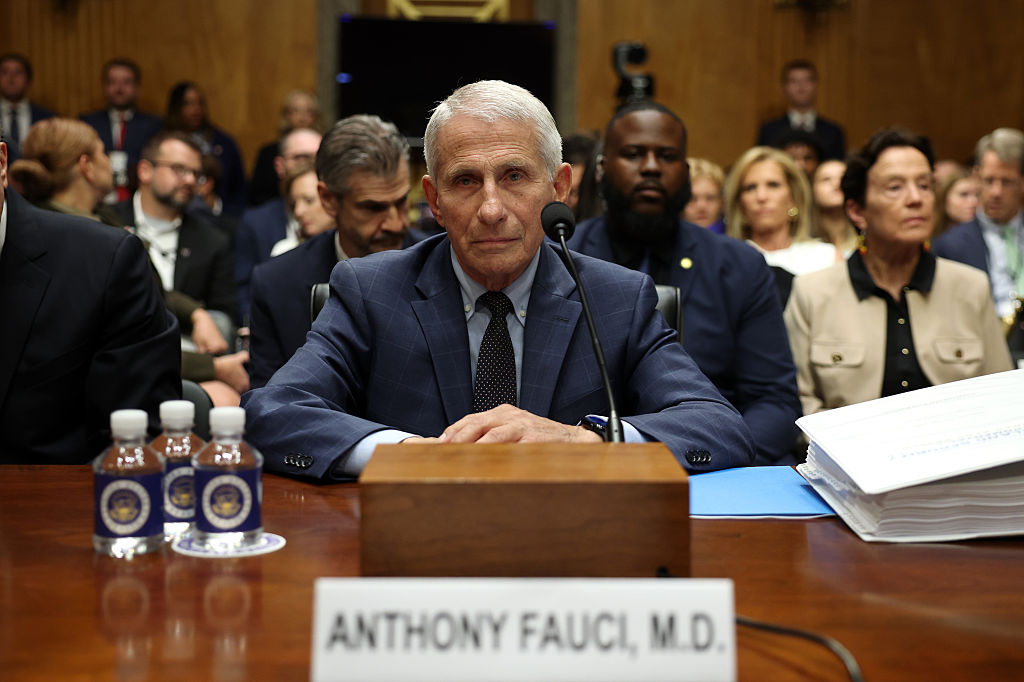
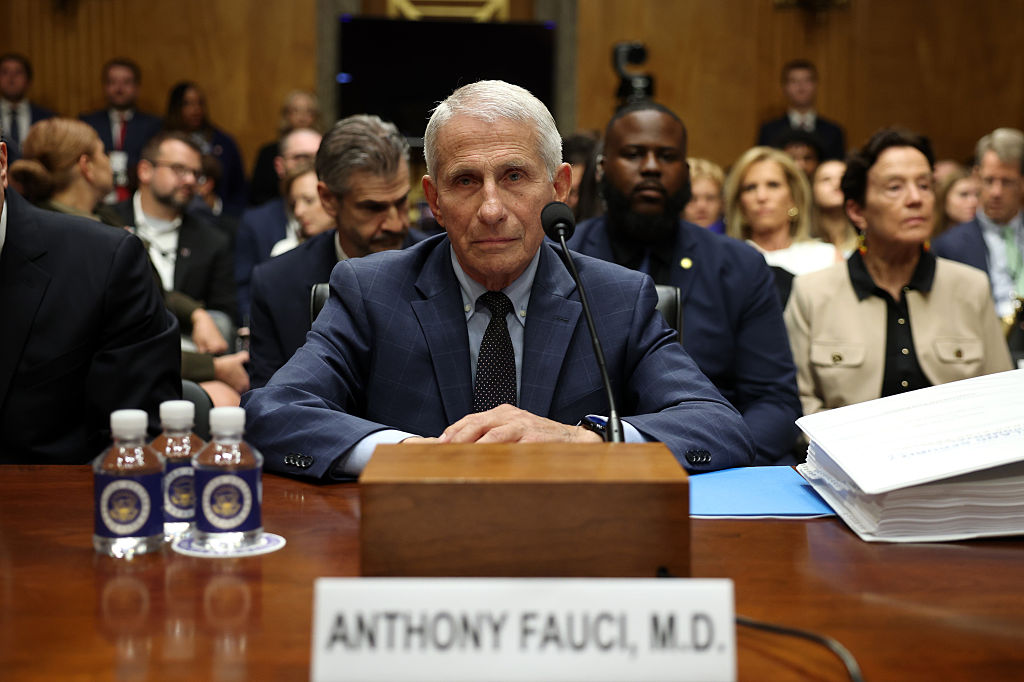
The Senate Homeland Security and Government Affairs Committee on Thursday voted to hold Dr. Anthony Fauci in contempt of Congress following a contentious hearing in which the infectious disease expert declined to answer lawmakers’ questions over 100 times.
Fauci, the former director of the National Institute of Allergy and Infectious Diseases (NIAID), repeatedly invoked his Fifth Amendment right against self-incrimination during a hearing last week, where Republican senators probed him over the U.S. government’s response to the COVID pandemic and the disputed origins of the virus. Fauci has long been a target of GOP attacks and investigations over his role in leading the pandemic response.
Read More: What It Means to Plead the Fifth Amendment
During his opening statement, Fauci accused Republican Sen. Rand Paul of Kentucky, the chair of the panel and one of his most persistent critics, of having an “obvious obsession with calling for my prosecution.”
“The only conclusion I can reach is that the sole reason he is calling me before this committee is to get me to say something, anything, that could vindicate his repeated public pledges that I end up, in his words, ‘behind bars,'” Fauci said.
His decision to plead the Fifth drew ire from GOP lawmakers. Paul pressed for Fauci to be held in contempt over his refusal to answer questions, arguing that he was not entitled to invoke his right against self-incrimination because he is protected from criminal prosecution over his past actions during the pandemic by a pardon granted by former President Joe Biden.
But as Biden’s pardon was retroactive, Republicans had said that any false statements Fauci made under oath during the hearing could still expose him to perjury charges. Fauci’s lawyer, David Schertler, said following the hearing that “We are completely confident that Dr. Fauci has a valid Fifth Amendment privilege here and is on solid legal ground in asserting it.”
On Thursday, the Republican-led committee voted 8-7 along party lines to advance the contempt resolution.
Here’s what to know about what that vote means, and what might come next for Fauci.
What does it mean to be held in contempt of Congress?
Contempt of Congress is a federal misdemeanor in which an individual willfully disobeys or impedes a congressional investigation.
A contempt of Congress charge may be levied against someone if they fail to appear before a committee after being subpoenaed, refuse to produce required documents, or refuse to answer questions related to an investigation.
Congress does not hold the power to prosecute or convict someone of the crime; instead, the House or Senate can vote to approve a resolution finding a person in contempt and refer the matter to the executive branch for prosecution.
What comes next after the Senate committee vote?
Under Senate procedure, following a panel vote to approve a contempt resolution like the one on Thursday, the measure then heads to the full chamber for a vote. If it passes there, the case is certified and sent to the Department of Justice (DOJ).
As Democratic support would be needed to reach the 60-vote threshold required to end a filibuster in the current narrowly divided Senate, the resolution to hold Fauci in contempt has little chance of passing the upper chamber.
“The vote is largely symbolic, because the full Senate would have to approve to hold Fauci in contempt,” Barbara McQuade, a former Obama-appointed U.S. attorney and expert in criminal procedure who is currently a professor at the University of Michigan law school, tells TIME in a statement. “It seems unlikely they will muster the 60 votes needed to get past a filibuster.”
Following the panel vote on Thursday, Paul said he would bypass the Senate vote and hand-deliver the resolution to the DOJ.
“This way we don’t sit a month waiting to determine whether or not to bring it to the Senate floor,” he told reporters on Thursday. “It will immediately be referred over and I think it’s important for them to look at.”
Paul is within his right to submit a referral to the DOJ to investigate Fauci. But Donald K Sherman, a former Biden-era official who previously served as senior counsel for the ranking member on the Senate Homeland Security and Government Affairs Committee, says that within the procedural context of the contempt resolution, the Kentucky senator’s promises to go straight to the department are “silly theater.”
“It has absolutely no legal effect,” he tells TIME, adding that “any procedural defect in the contempt resolution undermines the Department of Justice’s ability to prosecute it.”
Jonathan David Shaub, a former Biden-era White House attorney and Obama-era DOJ adviser and current professor of law at the University of Kentucky, notes that precedent is already in place that protects the procedure of certifying a contempt resolution by the Senate to the DOJ.
He warns, however, that if the DOJ acts on Paul’s referral, it could set “a pretty striking precedent for allowing what is in essence a sort of single chairman to sort of engage in this kind of harassment of a single person, private person.”
What penalties could Fauci face?
If Fauci is found guilty of contempt of Congress in court, he could face a fine of up to $100,000 and a prison sentence of up to one year.
Prosecutors would first need to prove that Fauci was willfully in contempt of Congress, however, something Sherman says is “a not insignificant burden on the government to prove.”
Paul has argued that Fauci did not have the right to plead the Fifth during the hearing due toBiden’s pardon, which shields Fauci for prosecution over any federal offenses he might have committed from January 1, 2014, through Jan. 19, 2025.
“We are voting on whether a witness who has received the benefit of a sweeping federal pardon can be ordered by this committee to answer questions and then defy that order without consequence,” Paul said on Thursday ahead of the committee vote.
McQuade believes Fauci would have a “bulletproof motion to dismiss on Fifth Amendment grounds” if charges were brought against him.
“The pardon Biden gave to Fauci applies only to any crimes Fauci ‘may’ have committed before January 20, 2025,” she tells TIME. “Therefore, he has a reasonable fear that his testimony could be used against him in a criminal prosecution, and his invocation of the Fifth Amendment was proper, and cannot be used as a basis to hold him in contempt.”
Fauci’s case is unique, though, with little legal precedent for a prosecution or defense to draw from.
“All of this is relatively unexplored, the effect of a pardon on your ability to assert the Fifth Amendment doesn’t seem to have really been settled,” Shaub says.
What can Fauci do?
There is little Fauci can do to stop Congress from seeking to hold him in contempt at this stage.
“There’s a speech and debate clause in the Constitution that immunizes members of Congress for their actions,” Shaub points out. “So there’s nothing he can do to stop whatever is going to happen, except for make his arguments to the Department of Justice.”
The legal road ahead may be a long one. “This could play out over a very long time period,” Shaub says.
But he adds that such prolonged proceedings could work to Fauci’s advantage.
“Should it go on for a while, and a Democratic president wins the next election, and his appeal is still pending, then they could drop the case,” Shaub says. “Which would likely be his best strategy should he get prosecuted.”